NATURAL COMMUNITY
Hillside Prairie
Official MNFI community page
Overview
Hillside prairie is a grassland or savanna community that occurs on moderate to steep exposed slopes and crests of hills associated with river valleys, streams, or kettle lakes, surrounded by oak forest or oak savanna. This natural community is almost always found on south- to west-facing slopes, where exposure to sunlight is highest. Soils are typically strongly acid to neutral loamy sand or sandy loam, and often mixed with gravel. Hillside prairie is notable for supporting several state-listed plant species largely restricted to this community type.
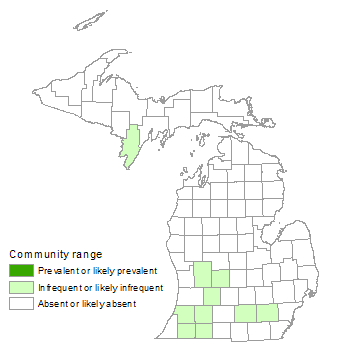
County distribution
Landscape Context
Hillside prairie occurs on steep slopes and crests of hills associated with river valleys, streams, or kettle lakes, surrounded by oak forest (dry southern forest, dry-mesic southern forest, or dry-mesic northern forest) or oak savanna (oak barrens or oak openings). This community almost always occupies south- to west-facing slopes, where exposure to sunlight is highest. It is found primarily in southern Lower Michigan, where occurrences are concentrated in Kent, Kalamazoo, and Jackson Counties. One occurrence is known from the western Upper Peninsula. Due to the specific combination of slope, aspect, and soil type, hillside prairie occurrences are local and of very small size.
Soils
Soils are well-drained, sandy loam to loamy sand and can range from strongly acid to neutral. Gravel is often present at or near the surface. One occurrence of hillside prairie is associated with exposed pre-glacial fluvial deposits of shale and conglomerate rocks.
Natural Processes
Open conditions of hillside prairie are maintained by fire, droughty soils, steep slopes, and soil erosion. Fire likely played a significant role in maintaining open conditions prior to European settlement based on the dominance of oaks in the surrounding landscape and presence of trails that led through or passed by several hillside prairie sites, suggesting their use as Native American encampments. In addition to preserving open conditions, fire helps maintain species diversity by facilitating seed germination, opening microsites for seedling establishment and growth of small species, and releasing important plant nutrients that bolster plant growth, flowering, and seed set. Several factors contribute to the droughty conditions of hillside prairie. Steep slopes and sandy soils facilitate rapid drainage. Exposed slopes of southerly to westerly aspect are exposed to high amounts of incident sunlight, which increases soil temperatures and the rate of evapotranspiration at the ground level. Xeric conditions on exposed hillsides and hilltops are further enhanced by the prevailing southwesterly winds, which increase water loss from plants and soils. Due to the steep slopes of hillside prairie, soil erosion and slumping are common. These processes contribute to maintaining open conditions and species diversity. Seed germination and seedling establishment of several small species may be aided by soil erosion and associated slumping as the bare soil patches provide suitable habitat for low-growing species that would otherwise be eliminated by competition from taller, more robust herbaceous plants.
Vegetation
Prior to European settlement and subsequent fire suppression, the canopy layer was likely absent to sparse, with scattered open-grown trees of black oak ( Quercus velutina ), white oak ( Q. alba ), pignut hickory ( Carya glabra ), and white pine ( Pinus strobus ). Currently, many remnants have locally dense canopies of the same species, in addition to the presence of mesophytic tree species that thrive in low-light conditions. Cover of the subcanopy and shrub layers has also increased in many hillside prairies due to a lack of fire. Characteristic species of the overstory, understory, and shrub layers include quaking aspen ( Populus tremuloides ), sassafras ( Sassafras albidum ), red-cedar ( Juniperus virginiana ), ironwood ( Ostrya virginiana ), witch hazel ( Hamamelis virginiana ), juneberry ( Amelanchier arborea ), staghorn sumac ( Rhus typhina ), and American hazelnut ( Corylus americana ). Remnant prairie openings, often very limited in extent, are typically dominated by little bluestem ( Schizachyrium scoparium ), big bluestem ( Andropogon gerardii ), porcupine grass ( Hesperostipa spartea ), and Pennsylvania sedge ( Carex pensylvanica ), with Indian grass ( Sorghastrum nutans ) occasionally important in more mesic microhabitats on middle and lower slopes. The invasive grasses Canada bluegrass ( Poa compressa ) and Kentucky bluegrass ( P. pratensis ) are common in most sites. Other commonly occurring ground flora include thimbleweed ( Anemone cylindrica ), milkweeds ( Asclepias spp.), asters ( Symphyotrichum spp.), harebell ( Campanula rotundifolia ), New Jersey tea ( Ceanothus americanus ), bastard toadflax ( Comandra umbellata ), flowering spurge ( Euphorbia corollata ), northern bedstraw ( Galium boreale ), round-leaved hepatica ( Hepatica americana ), alum root ( Heuchera spp.), cylindrical blazing star ( Liatris cylindracea ), northern blazing star ( L. scariosa ), hoary puccoon ( Lithospermum canescens ), hairy beard-tongue ( Penstemon hirsutus ), prairie ragwort ( Packera paupercula var. pseudotomentosa ), false Solomon's seal ( Maianthemum racemosum ), goldenrods ( Solidago spp.), birdfoot violet ( Viola pedata ), and summer grape ( Vitis aestivalis ). In Michigan, several rare plant species are nearly restricted to hillside prairie, including kitten-tails ( Besseya bullii , state endangered), side-oats grama grass ( Bouteloua curtipendula , state endangered), and prairie golden alexanders ( Zizia aptera , state threatened); their close affinity to hillside prairies allows them to serve as potential indicators for this community.
Biodiversity Management Considerations
Conservation priorities for hillside prairies include identifying, protecting, and managing existing remnants where they occur. Fire suppression has resulted in conversion of many hillside prairies to closed-canopy forests, and continues to threaten existing sites. Open conditions can be restored through the use of prescribed fire. The initial step of cutting and herbiciding shrubs and trees may be necessary in overgrown sites. The sand and gravel substrate on steep slopes is prone to erosion, so care must be taken to prevent excessive foot traffic and soil disturbance. Invasive species can be controlled with fire, cutting, and herbicide application. Because several rare plants are nearly restricted to this habitat in Michigan, land stewards should take precautions to avoid direct impacts to these species from herbicide or excessive soil disturbance. Much of our current knowledge of hillside prairie is based on studies of kitten-tails populations in Michigan, Indiana, Illinois, Wisconsin, and Minnesota. Current and historic locations for kitten-tails, side-oats grama, and other indicator species may serve as a guide to the locations of additional, potentially restorable former hillside prairies. Predictive GIS-based models that utilize landscape characteristics associated with the community may also be helpful in finding restorable sites. Soil erosion, gravel mining, road construction, dumping, and invasive species all act as threats to the viability of hillside prairie. Invasive species that threaten the diversity and community structure of hillside prairie include spotted knapweed ( Centaurea stoebe ), common St. John's-wort ( Hypericum perforatum ), autumn olive ( Elaeagnus umbellata ), multiflora rose ( Rosa multiflora ), common buckthorn ( Rhamnus cathartica ), Eurasian honeysuckles ( Lonicera maackii , L . morrowii , L . tatarica , and L . x bella ), and black locust ( Robinia pseudoacacia ). Other non-native plants, such as Canada bluegrass ( Poa compressa ), Kentucky bluegrass ( P. pratensis ), sheep sorrel ( Rumex acetosella ), and hawkweeds ( Hieracium spp.), can be ubiquitous within hillside prairie remnants, yet their impacts on overall species composition and diversity have not been studied. The landscape context of hillside prairies on steep, often scenic bluffs overlooking permanent bodies of water has led to the destruction of many remnants due to residential construction.
Variation
Middle and lower slopes may support mesic and wet-mesic conditions, respectively. White pine is an important canopy constituent in some occurrences.
Associated plants
-
Graminoids
big bluestem Andropogon gerardii
-
Graminoids
side-oats grama Bouteloua curtipendula
-
Graminoids
Pennsylvania sedge Carex pensylvanica
-
Graminoids
poverty grass Danthonia spicata
-
Graminoids
porcupine grass Hesperostipa spartea
-
Graminoids
wood-rushes Luzula acuminata, multiflora
-
Graminoids
little bluestem Schizachyrium scoparium
-
Graminoids
Indian grass Sorghastrum nutans
-
Forbs
thimbleweed Anemone cylindrica
-
Forbs
wild columbine Aquilegia canadensis Species guide available Wild Columbine
-
Forbs
milkweeds Asclepias amplexicaulis, verticillata
-
Forbs
kitten-tails Besseya bullii
-
Forbs
harebell Campanula rotundifolia
-
Forbs
spring-beauty Claytonia virginica
-
Forbs
bastard-toadflax Comandra umbellata
-
Forbs
common whitlow-grass Draba reptans
-
Forbs
robin’s-plantain Erigeron pulchellus
-
Forbs
flowering spurge Euphorbia corollata
-
Forbs
American columbo Frasera caroliniensis
-
Forbs
northern bedstraw Galium boreale
-
Forbs
pale avens Geum virginianum
-
Forbs
round-leaved hepatica Hepatica americana
-
Forbs
alum roots Heuchera richardsonii, americana
-
Forbs
cylindrical blazing-star Liatris cylindracea
-
Forbs
northern blazing-star Liatris scariosa
-
Forbs
hoary puccoon Lithospermum canescens
-
Forbs
false spikenard Maianthemum racemosum
-
Forbs
prairie ragwort Packera paupercula
-
Forbs
hairy beard-tongue Penstemon hirsutus
-
Forbs
Seneca snakeroot Polygala senega
-
Forbs
early buttercup Ranunculus fascicularis
-
Forbs
old-field goldenrod Solidago nemoralis
-
Forbs
elm-leaved goldenrod Solidago ulmifolia
-
Forbs
asters Symphyotrichum laeve, urophyllum, sericeum
-
Forbs
yellow-pimpernel Taenidia integerrima
-
Forbs
early meadow-rue Thalictrum dioicum
-
Forbs
rue-anemone Thalictrum thalictroides
-
Forbs
birdfoot violet Viola pedata
-
Forbs
prairie golden alexanders Zizia aptera
-
Woody Vines
summer grape Vitis aestivalis
-
Shrubs
New Jersey tea Ceanothus americanus
-
Shrubs
dogwoods Cornus
-
Shrubs
American hazelnut Corylus americana
-
Shrubs
witch-hazel Hamamelis virginiana
-
Shrubs
winged sumac Rhus copallina
-
Shrubs
staghorn sumac Rhus typhina
-
Trees
juneberry Amelanchier arborea
-
Trees
pignut hickory Carya glabra
-
Trees
flowering dogwood Cornus florida
-
Trees
red-cedar Juniperus virginiana
-
Trees
ironwood Ostrya virginiana
-
Trees
white pine Pinus strobus
-
Trees
quaking aspen Populus tremuloides
-
Trees
white oak Quercus alba
-
Trees
black oak Quercus velutina
-
Trees
sassafras Sassafras albidum
MNFI via Ecological Commons