NATURAL COMMUNITY
Dry-mesic Southern Forest
Official MNFI community page
An oak-dominated woodland community found on well-drained soils across parts of Southeast Michigan.
Overview
Dry-mesic southern forest is a fire-dependent, oak or oak-hickory forest type on generally dry-mesic sites found south of the climatic tension zone in southern Lower Michigan. Frequent fires maintain semi-open conditions, promoting oak regeneration and ground and shrub layer diversity.
County distribution
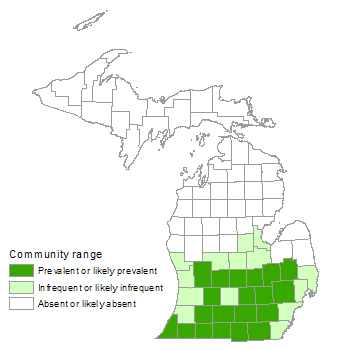
Landscape Context
This natural community occurs principally on glacial outwash, coarse-textured moraines, sandy glacial lakeplains, kettle-kame topography, and sand dunes.
Soils
Soils are typically sandy loam or loam and slightly acid to neutral in pH.
Natural Processes
Fire, windthrow, and insect outbreaks and pathogens associated with oak defoliation and decline are the prevalent natural disturbance factors influencing dry-mesic southern forest. Historically, frequent, low-intensity surface fires generated conditions suitable for sustaining advanced oak regeneration and helped keep oak pathogens and invertebrate acorn predators at low levels. Tree density in circa 1800 oak forests was likely lower than that observed today under conditions of fire suppression, and helped limit root-grafting and the spread of several oak pathogens. Frequent small-scale wind disturbance or gap-phase dynamics allows for growth of suppressed oak saplings and canopy ascension of understory oaks. Prolonged periods of fire suppression in oak openings can result in the succession to closed-canopy dry-mesic southern forest and likely accounts for the existence of many oak forests observed today.
Vegetation
The canopy layer generally is dominated or codominated by white oak ( Quercus alba ) and black oak ( Quercus velutina ), with white oak being the more frequent dominant. Red oak ( Q. rubra ) can occur as a canopy codominant, especially where soils and topographic position favor less droughty conditions such as north- to east-facing slopes and footslopes. Hickories such as pignut hickory ( Carya glabra ) , shagbark hickory ( C. ovata ), and bitternut hickory ( C. cordiformis ) are often canopy codominants. Prevalent canopy associates may include red maple ( Acer rubrum ), white ash ( Fraxinus americana ), black cherry ( Prunus serotina ), Hill's oak ( Quercus ellipsoidalis ), basswood ( Tilia americana ), and sassafras ( Sassafras albidum ). Prevalent species of the subcanopy include red maple, hickories, alternate-leaved dogwood ( Cornus alternifolia ), flowering dogwood ( C. florida ), ironwood ( Ostrya virginiana ), cherries ( Prunus spp.), and sassafras. Characteristic shrubs include serviceberries ( Amelanchier spp.) , witch hazel ( Hamamelis virginiana ), and choke cherry ( Prunus virginiana ). In fire-suppressed systems, mesophytic trees and shrubs are often dominant in the subcanopy and shrub layers. Typical herbaceous species include doll's eyes ( Actaea pachypoda ), hog peanut ( Amphicarpaea bracteata ), jack-in-the-pulpit ( Arisaema triphyllum ), bearded shorthusk ( Brachyelytrum erectum ), hairy woodland brome ( Bromus pubescens ), white bear sedge ( Carex albursina ), rosy sedge ( C. rosea ), enchanter's nightshade ( Circaea canadensis ), spotted coral-root ( Corallorhiza maculata ), pointed-leaf tick-trefoil ( Hylodesmum glutinosum ), naked-flower tick-trefoil ( H. nudiflorum ), fragrant bedstraw ( Galium triflorum ), black snakeroot ( Sanicula marilandica ), bristly greenbrier ( Smilax hispida ), large-flowered bellwort ( Uvularia grandiflora ), and downy yellow violet ( Viola pubescens ).
Biodiversity Management Considerations
Fire is the single most significant factor in preserving oak ecosystems. The use of prescribed fire is an imperative management tool for promoting oak regeneration, deterring the succession of shade-tolerant species, and reducing the encroachment by invasive shrubs such as honeysuckles and autumn olive. Fire management should be orchestrated in conjunction with the management of fire-dependent communities such as oak barrens, dry sand prairie, prairie fen, and coastal plain marsh. Many current dry-mesic southern forests are degraded oak openings that have been long deprived of fire. Open canopy conditions can be restored by mechanical thinning or girdling. Restored sites will need to be maintained by periodic prescribed fire and may require investment in native plant seeding where seed and plant banks are inadequate. Herbicide application to stumps is likely necessary where woody invasive species or red maple are well established. Monitoring and control efforts to detect and remove invasive species are critical to the long-term viability of dry southern forest. Invasive species that threaten the diversity and community structure include garlic mustard ( Alliaria petiolata ), black swallow-wort ( Vincetoxicum nigrum ), white swallow-wort ( V . rossicum ), Oriental bittersweet ( Celastrus orbiculatus ), common buckthorn ( Rhamnus cathartica ), autumn olive ( Elaeagnus umbellata ), Eurasian honeysuckles ( Lonicera morrowii , L. japonica , L. maackii , L. tatarica , L . x bella , and L. xylosteum ), multiflora rose ( Rosa multiflora ), and Norway maple ( Acer platanoides ).
Variation
Red oak can occur as a codominant on moister soils. Toward the transition zone, white pine ( Pinus strobus ) becomes a canopy associate.
Associated plants
-
Graminoids
autumn bent Agrostis perennans
-
Graminoids
long-awned wood grass Brachyelytrum erectum
-
Graminoids
Canada brome Bromus pubescens
-
Graminoids
sedges Carex albursina, cephalophora, communis, digitalis, pensylvanica, rosea
-
Graminoids
poverty grass Danthonia spicata
-
Graminoids
panic grasses Dichanthelium
-
Graminoids
bottlebrush grass Elymus hystrix
-
Graminoids
nodding fescue Festuca subverticillata
-
Graminoids
cut-leaved rice-grass Oryzopsis asperifolia
-
Forbs
doll’s eyes Actaea pachypoda
-
Forbs
tall agrimony Agrimonia gryposepala
-
Forbs
hog-peanut Amphicarpaea bracteata
-
Forbs
wild columbine Aquilegia canadensis Species guide available Wild Columbine
-
Forbs
wild sarsaparilla Aralia nudicaulis
-
Forbs
poke milkweed Asclepias exaltata
-
Forbs
false foxglove Aureolaria
-
Forbs
enchanter’s-nightshade Circaea canadensis
-
Forbs
wild yam Dioscorea villosa
-
Forbs
large-leaved aster Eurybia macrophylla
-
Forbs
bedstraws Galium circaezans, triflorum
-
Forbs
wild geranium Geranium maculatum Species guide available Wild Geranium
-
Forbs
round-leaved hepatica Hepatica americana
-
Forbs
pointed-leaf tick-trefoil Hylodesmum glutinosum
-
Forbs
naked-flower tick-trefoil Hylodesmum nudiflorum
-
Forbs
Canada mayflower Maianthemum canadense
-
Forbs
false spikenard Maianthemum racemosum
-
Forbs
hairy sweet cicely Osmorhiza claytonii
-
Forbs
jumpseed Persicaria virginiana
-
Forbs
lopseed Phryma leptostachya
-
Forbs
may apple Podophyllum peltatum
-
Forbs
large-leaved shinleaf Pyrola elliptica
-
Forbs
black snakeroots Sanicula
-
Forbs
bluestem goldenrod Solidago caesia
-
Forbs
elm-leaved goldenrod Solidago ulmifolia
-
Forbs
early meadow-rue Thalictrum dioicum
-
Forbs
rue-anemone Thalictrum thalictroides
-
Forbs
common trillium Trillium grandiflorum
-
Forbs
large-flowered bellwort Uvularia grandiflora
-
Forbs
merrybells Uvularia sessilifolia
-
Forbs
downy yellow violet Viola pubescens
-
Ferns
rattlesnake fern Botrypus virginianus
-
Ferns
bracken fern Pteridium aquilinum
-
Woody Vines
Virginia creeper Parthenocissus quinquefolia
-
Woody Vines
bristly greenbrier Smilax hispida
-
Woody Vines
poison-ivy Toxicodendron radicans
-
Woody Vines
summer grape Vitis aestivalis
-
Woody Vines
riverbank grape Vitis riparia
-
Shrubs
serviceberries Amelanchier
-
Shrubs
gray dogwood Cornus foemina
-
Shrubs
American hazelnut Corylus americana
-
Shrubs
wintergreen Gaultheria procumbens
-
Shrubs
huckleberry Gaylussacia baccata
-
Shrubs
witch-hazel Hamamelis virginiana
-
Shrubs
choke cherry Prunus virginiana
-
Shrubs
prickly gooseberry Ribes cynosbati
-
Shrubs
common blackberry Rubus allegheniensis
-
Shrubs
black raspberry Rubus occidentalis
-
Shrubs
wild red raspberry Rubus strigosus
-
Shrubs
low sweet blueberry Vaccinium angustifolium
-
Shrubs
Canada blueberry Vaccinium myrtilloides
-
Shrubs
hillside blueberry Vaccinium pallidum
-
Shrubs
maple-leaved arrow-wood Viburnum acerifolium
-
Trees
red maple Acer rubrum
-
Trees
juneberry Amelanchier arborea
-
Trees
bitternut hickory Carya cordiformis
-
Trees
pignut hickory Carya glabra
-
Trees
shagbark hickory Carya ovata
-
Trees
alternate-leaved dogwood Cornus alternifolia
-
Trees
flowering dogwood Cornus florida
-
Trees
white ash Fraxinus americana
-
Trees
ironwood Ostrya virginiana
-
Trees
black cherry Prunus serotina
-
Trees
white oak Quercus alba
-
Trees
northern pin oak Quercus ellipsoidalis
-
Trees
red oak Quercus rubra
-
Trees
black oak Quercus velutina
-
Trees
sassafras Sassafras albidum
-
Trees
basswood Tilia americana
MNFI via Ecological Commons